Where you host your Odoo MCP server decides almost everything else
Local laptop, embedded Odoo module, self-hosted VPS, or fully managed: four ways to set up an MCP server for Odoo, with honest tradeoffs and how to pick the one you won't regret.
Discover strategies, case studies and news about ERP implementations, Odoo and AI-driven efficiency for businesses.
Local laptop, embedded Odoo module, self-hosted VPS, or fully managed: four ways to set up an MCP server for Odoo, with honest tradeoffs and how to pick the one you won't regret.
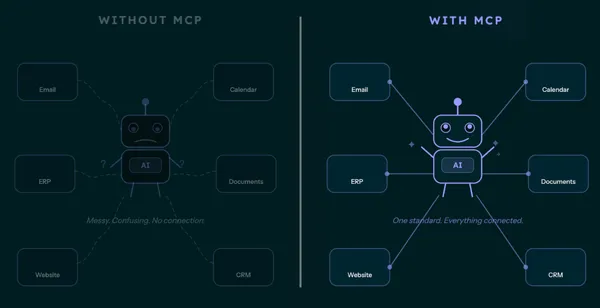
Most people use AI as a search engine or a text editor. MCP goes further: it connects your AI agent to your ERP, CRM, mailbox, calendar, CMS and more, so it doesn't just answer, it takes action.
Odoo has AI built in, but a dedicated AI assistant like Claude, ChatGPT, Copilot or Gemini works across all your tools: mail, calendar, storage and Odoo. Five advantages, plus when Odoo's own AI is the better choice.
Guide coming soon. Send us a message if you'd like to connect Le Chat to your Odoo.
Guide coming soon. Send us a message if you'd like to connect Copilot to your Odoo.
Guide coming soon. Send us a message if you'd like to connect Gemini to your Odoo.
Connect ChatGPT to your Odoo instance in a few clicks via the Odoo MCP Pro connector. Search, read, and edit your business data with natural language, no CSV exports, no switching tabs.
Connect Claude AI to your Odoo instance in a few clicks via the Odoo MCP Pro connector. Search, read, and edit your business data with natural language — no CSV exports, no switching tabs.
White Paper AI doesn't change the rules of your ERP. It changes the speed. This paper maps the gap between AI ambition and execution, argues that governance doesn't change when the interface does, and shows what actually works today in Odoo and beyond.
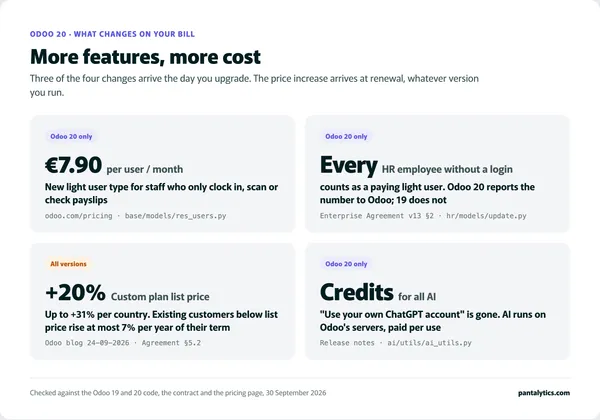
Odoo 20 is expected in September/October 2026. We highlight the most relevant new features for our customers, by domain, concise and to the point.
9 projects connect Odoo to AI via MCP. Which one works on your phone, your laptop, or both? A fair comparison.
Odoo 19 introduces native AI, but the implementation leaves opportunities on the table. Pantalytics adds Anthropic Claude as a third provider, builds web search per agent, and improves AI Fields with automation, per-field model selection, and human-edit protection.
Imagine asking in plain English which invoices are overdue, and your AI assistant looks it up directly in Odoo. No exports, no switching tabs. We built the open-source bridge between Claude and Odoo.
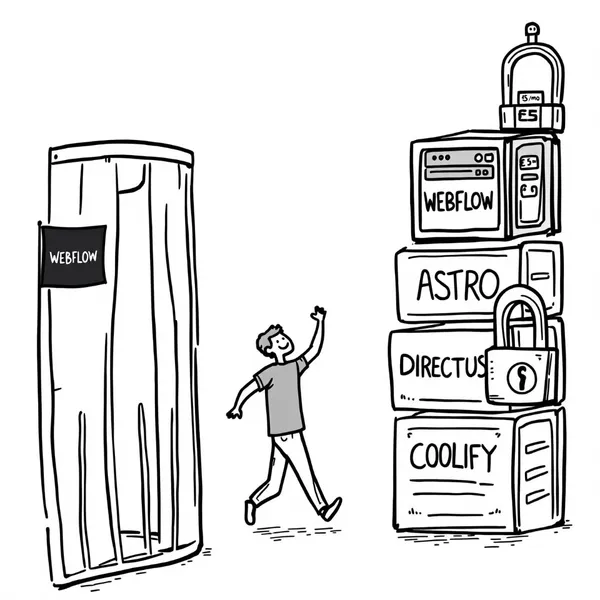
Pantalytics preaches data ownership and open source — so we had to practice what we preach. In one day, we migrated our website from Webflow to Astro + Directus + Coolify: new positioning, additional pages, privacy-friendly analytics and a security audit included.
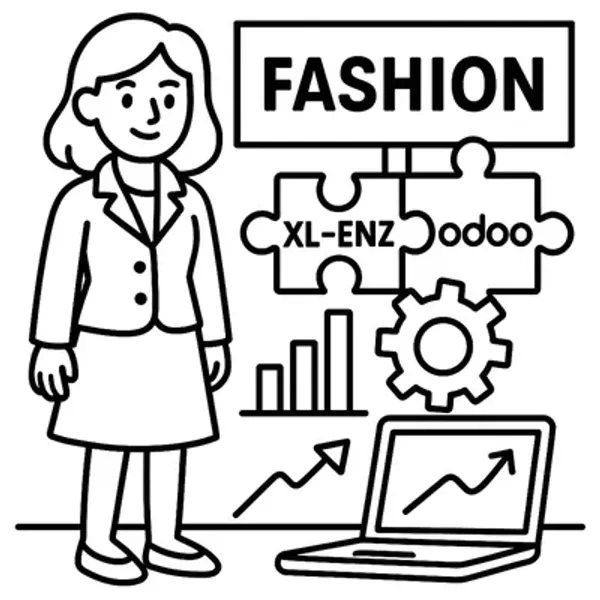
Fashion companies running on XL-ENZ (Reflecta) are under pressure to integrate processes, leverage data better, and simplify IT. This decision blog compares XL-ENZ and Odoo on process fit, integrations, data/BI, governance, risks, and TCO. Includes migration impact, AI use cases, and practical decision steps.
Many organizations reach a point where their existing ERP no longer keeps up with growth. This blog compares a finance-first SaaS ERP (like Visma Net) with Odoo as a broad suite. You'll learn about differences in functional fit, integrations, data/governance, AI, costs and risks, plus when optimizing, extending or migrating makes sense.
Many SMEs are reconsidering their ERP: optimize in Uniconta or migrate to Odoo. This blog compares both on functional coverage (finance, inventory, project, production), extensibility, integrations/APIs, BI/AI, compliance, and total cost of ownership (TCO). Includes risks, migration approach, and a practical decision matrix with fit-gap workshops and PoC steps.
This blog helps Dutch project-driven construction companies choose between Treetop Online and Odoo. Treetop offers construction-specific flows and fast adoption, but has continuity risk due to discontinued development. Odoo is more future-proof, broader, and better integrable, but requires explicit process design, migration approach, governance, and change management for successful implementation and adoption.
Many SMEs are outgrowing their current ERP and must choose: keep developing, replace, or hybrid. This blog compares TRADIUM and Odoo on process fit versus platform fit, logistics/WMS, traceability, production, and service, plus integrations, data sovereignty, reporting, and AI. Includes risks, governance, TCO, migration impact, and a practical decision framework.
When do you keep optimizing Torza ERP and when does a migration to Odoo make sense? This blog compares both for manufacturing companies and technical wholesalers: order-to-cash, purchase-to-pay, WMS/inventory, batch and unit production, quality and certificates, integrations, BI, security, and costs. Includes due diligence questions, PoC flows, and decision criteria.
Mid-market manufacturers often wonder: optimize SYSPRO or migrate to Odoo? This blog contrasts sector specialization and process depth (SYSPRO) with modular breadth and fast extensibility (Odoo). You'll read differences in integration, data governance, analytics, AI, hosting, and TCO, plus scenarios and next steps via fit-gap and proof-of-concept.
Many fashion and footwear companies outgrow their ERP without it being broken. This blog compares STYLEman (sector suite) with Odoo (modular platform) on strategic fit, process fit, data/AI, TCO, and implementation risks. Includes differences in variant and collection management, integrations, governance, and migration impact.
This blog helps management, operations and IT determine whether the existing Solidbricks ERP still fits or whether Odoo is a better match. You get a neutral comparison of process fit, functionality, integrations, security, AI and roadmap risk. Includes scorecard, decision matrix and TCO approach, plus a step-by-step plan for fit-gap, integration scan and Proof-of-Value.
Growing service providers run into the limits of their PSA/ERP landscape. This article compares Simplicate and Odoo neutrally: positioning, functional fit, reporting, integrations, governance and data/AI. It helps determine when Simplicate suffices and when Odoo fits, including TCO, migration risks, adoption and next steps.
This blog helps food and fresh produce companies choose between modernising with Si Foodware (Dynamics vertical) or switching to Odoo (modular platform). You read about differences in sector fit, lot/quality/traceability, EDI, integrations, BI and AI. Includes TCO, migration impact, governance and practical next steps for an objective fit-gap and business case.
Many organizations are reconsidering their ERP due to rising costs, changing processes and stricter data and compliance requirements. This blog compares SAP (ECC/S/4HANA) and Odoo on core processes, reporting/embedded analytics, integration, AI, security and data sovereignty. No winner, but trade-offs, risks, TCO drivers and a concrete fit-gap approach for objective decision-making.
Many organizations outgrow their ERP and face the choice: optimize Sage or switch to Odoo. This article compares Sage X3 and Intacct with Odoo on process fit, suite coverage, integrations, AI, governance, data sovereignty and TCO. With attention to risks, migration impact and practical next steps per role.
This blog helps manufacturing companies determine whether to stay with an ECI ERP (JobBOSS², Deacom, Macola, M1) or whether switching to Odoo is logical. We compare sector-specific manufacturing depth versus one unified platform, including integrations, traceability/QC, finance, AI, security and TCO. With decision matrix, PoC scenarios and migration risks for go/no-go.
Rental organisations face a choice: stay with a rental suite like RentMagic, or migrate to Odoo as a broad ERP. This article offers a practical decision framework covering process fit, scalability, integrations, data/reporting, governance and TCO. Includes attention to AI, migration risks, PoC approach and next steps for well-founded decision-making.
Many Benelux wholesalers and manufacturers are running up against the limits of their ERP. This blog compares Real Applied Wholesale (RAW) with Odoo: logistics depth and complex pricing versus platform breadth, ecosystem and international scale. Focuses on WMS, finance, integrations, data governance, AI, risks, TCO and concrete next steps for fit-gap and PoC.
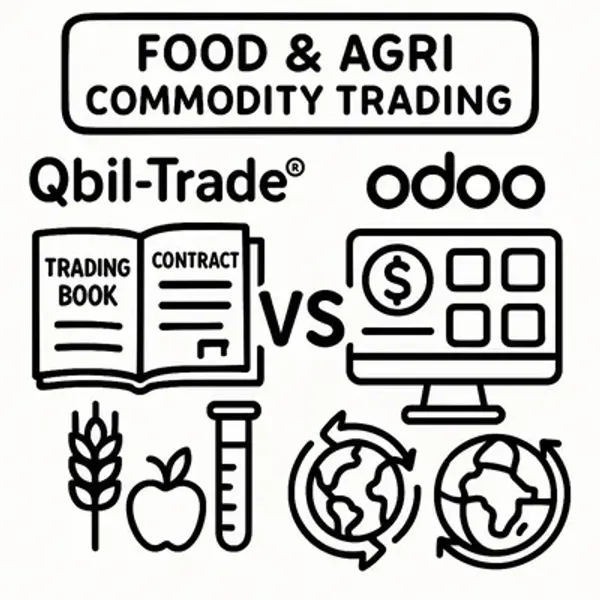
This blog compares Qbil-Trade® and Odoo for food & agri commodity trading. Qbil-Trade® excels in trading book, contract and call-off logic, trade documents and traceability/compliance. Odoo offers broader suite, finance integration, standardisation and ecosystem. Includes criteria for TCO, integration, AI, governance, migration risks and practical next steps.
This blog helps international manufacturers make a strategic choice between QAD Cloud ERP and Odoo. No feature checklist, but fit, trade-offs and risks: manufacturing depth, supply chain complexity, global compliance, integration architecture, governance, data/AI, data sovereignty and TCO. Includes a scorecard, PoC approach and migration and transition considerations.
Many SMEs running Prodin face a dilemma: stay, optimize or migrate to Odoo. This blog compares industry-focused suite ERP with modular platform ERP across trade, production, service, finance, reporting, integrations and AI opportunities. Includes TCO, migration risks, data quality, governance and a scorecard approach to make trade-offs explicit and structure decision-making.
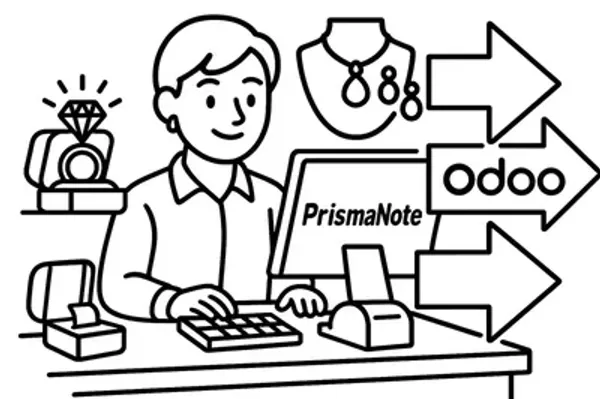
Many jewelers use PrismaNote for POS, inventory and repairs, but growth and governance sometimes call for a broader ERP. This blog compares PrismaNote with Odoo and outlines three scenarios: stay, hybrid (frontstore PrismaNote, backoffice Odoo) or full migration. Including integration, data, AI, compliance and TCO.
Many organizations hesitate between optimizing Priority ERP or reconsidering with Odoo. This blog offers a neutral decision framework: functional fit for finance, inventory, manufacturing and WMS; scalability and multi-entity; integrations, portals and governance; data, analytics and AI; and TCO, migration risks and next steps toward fit-gap and PoC.
This blog helps print companies decide between PrintVis on Microsoft Dynamics 365 Business Central and Odoo. We compare process fit for estimating, planning and shopfloor, broad business functionality, integrations (JDF vs API), data/BI and AI. We also cover lock-in, hosting, migration, change, costs and risks, and outline scenarios: optimize, switch or hybrid.
Many Dutch mid-market organizations hesitate between Pluriform (integrated suite with industry models) and Odoo (modular platform with ecosystem). This blog compares fit per sector, customization strategy, integrations, governance, TCO and lock-in. With due diligence and a fit-gap/proof-of-concept, you prevent choices based on demos and limit implementation risks.
This blog helps management, operations and IT choose between paSys ERP (food-specific) and Odoo (modular platform). We compare traceability, batch/shelf-life, recipe management, shop floor/WMS, EDI and hardware integrations versus suite breadth, ecosystem, APIs and multi-company. Including risks, TCO, migration impact, governance, security/GDPR, and a practical scorecard and PoC framework for decision-making.
Wholesalers often outgrow their ERP due to more channels, higher volumes and stricter compliance. This blog compares ParagonERP (wholesale focus, fast core flows, ParagonBI on BigQuery) with Odoo (modular platform, broad ecosystem, flexible deployment). You get trade-offs around WMS, integrations, governance, data/BI, lock-in, migration, TCO and next steps.
This blog compares an existing order- and logistics-driven ERP (Order-Direct) with Odoo. Read where each system is stronger, how process fit, customisation, UX, governance and integrations determine the choice, and what hosting means for security. Including AI and data questions, TCO/ROI, migration risks and practical next steps.
This blog helps management, operations and IT choose between staying on ORDAS or migrating to Odoo. We compare sector fit, suite structure, extensibility, integrations, data/BI/AI, costs and risks. ORDAS scores on out-of-the-box sector processes; Odoo on one integrated suite, ecosystem and scalability. Including checklist, TCO structure and next steps.
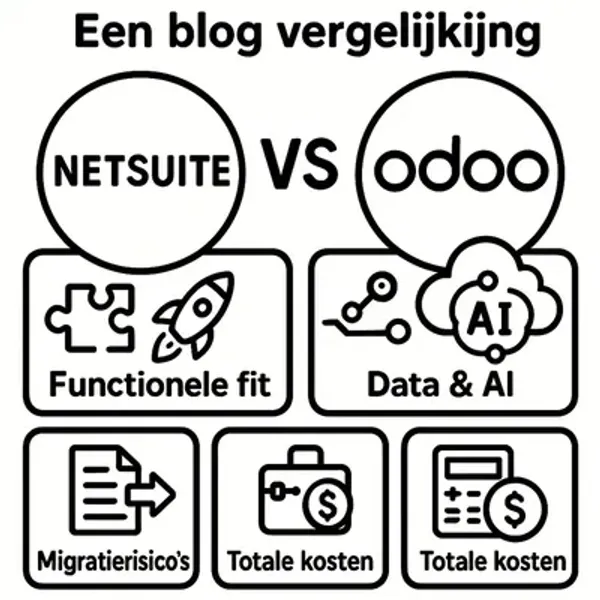
This article compares NetSuite and Odoo as a core ERP across functional fit, strategic agility, data & AI, migration risks and total cost. NetSuite is strong on multi-entity, consolidation and SaaS governance; Odoo on modularity, time-to-change and hosting choice. Includes integration, data migration and TCO scenarios plus practical next steps.
Many logistics companies use a sector suite like NaviTrans on Business Central, but growth and integration pressure make a reconsideration towards Odoo or a hybrid model logical. This blog compares logistics depth, platform breadth, integrations, governance, AI/data, TCO and migration risks.
Many organisations outgrow their ERP and seek more agility, compliance and less integration friction. This article compares MyFactory Cloud ERP with Odoo (Community/Enterprise) on positioning, production, finance, CRM, e-commerce, data/BI, integrations and AI. Including risks, migration impact, TCO structure and a practical POC approach with scenarios.
This article helps organisations decide whether optimising Microsoft Dynamics 365 Business Central or migrating to Odoo is strategically a better fit. Using criteria like fit-to-standard, extensibility, data/AI, TCO and migration risk, it weighs the differences per domain, integrations, governance and hosting. Includes scenarios, cost components and practical next steps.
Project-driven service providers face a choice: a specialist project ERP (Deltek Maconomy) with deep project accounting, WIP and governance, or a modular platform (Odoo) that brings multiple departments onto one suite. This comparison covers functional fit, reporting/BI, integrations, extensibility, hosting/data sovereignty, costs, migration risks and a practical decision framework.
When is it rational to keep and optimise Logic4, and when does a switch to Odoo pay off? This blog compares both from management, operations and IT perspectives. You get insight into process fit (order-to-cash, inventory, finance), integrations and data/AI, TCO and migration risks, plus a scorecard and next steps.
Many manufacturing companies hesitate between optimising a sector-specific ERP like Komdex and migrating to platform ERP Odoo. This blog compares process fit, strategic scope and IT aspects: shop floor, calculation/post-calculation, CAD/PDM, integrations, data/BI and governance. It also covers AI, data sovereignty, costs, migration risks and an approach for objective validation.
Many organisations reach an ERP tipping point: continue developing, replace or consolidate. This blog compares KING ERP and Odoo for inventory-driven businesses. We discuss process fit (WMS, traceability, e-commerce, EDI), IT architecture and integrations, AI/data foundation, risks and uncertainties, plus migration impact and TCO. Concluding: decision framework, validation questions and next steps.
Many organisations are reconsidering their ERP due to growth, compliance, cloud strategy and data needs. This blog compares Jeeves ERP and Odoo without picking a winner: Jeeves excels in industrial depth, projects, configurator and intercompany; Odoo in ecosystem, suite breadth, UX and integration speed. Including BI/AI, integration, data sovereignty, TCO and PoC checklist.
This article compares two ERP routes for fashion companies: itSuitsFashion as sector solution on top of Microsoft Dynamics 365 Business Central versus Odoo as broad, modular suite. It covers process fit (variants, seasons, wholesale), multichannel, integrations, AI, data governance, TCO and implementation risk. Including decision framework and concrete next steps for selection, demos and migration.
Many manufacturing companies hesitate between staying on Isah, with deep manufacturing, engineering and shop floor focus, or switching to Odoo as a modular platform for end-to-end processes. This blog identifies fit-gaps around ETO/projects, service/portals, integrations, data/AI, governance and TCO. Including risks, migration impact and practical next steps.
When growth, internationalisation or compliance requirements increase pressure, the choice between ionBIZ and Odoo becomes strategic. This blog compares both per domain: project-to-cash, planning, timesheets, project margins, invoicing, CRM, ticketing, procurement, reporting, integrations and governance. Including TCO, migration risks, data sovereignty and a practical POC framework for selection.
This article compares Infor and Odoo for organisations growing in sites, compliance and chain complexity. Infor stands out in industry-specific CloudSuites, deep manufacturing processes, enterprise integration and embedded analytics (Birst). Odoo scores with modular expansion, uniform UX and fast implementation, but requires tight governance to manage customisation and scope creep.
This article compares IFS (existing core platform) with Odoo from process criticality, architecture, integrations, data/BI, AI and TCO. IFS excels in EAM/FSM and complex project delivery with enterprise governance and deployment options. Odoo offers modular growth and fast standard processes but requires tight governance. Includes migration scenarios, risks and next steps.
When your current ERP or information management system no longer scales, the choice arises: optimise iConnect or migrate to Odoo. This article compares both on working model (file versus process), functionality, integrations, reporting, AI, governance and risks. Including TCO, migration complexity and checklist for management, operations and IT.
Growing construction and installation companies face more complex planning, material flows and margin management. This blog compares HERO (sector-specific: planning, work orders, mobile app, project file) with Odoo (modular suite ERP: finance, purchasing, inventory, multi-company, reporting). Including scorecard, integration/AI considerations, TCO and switching risks, plus checklist for decision-making.
When growth, standardisation and digitalisation increase, the choice between Gilde and Odoo becomes relevant. This blog compares industry ERP versus modular platform for project-driven construction/maintenance SME: process fit, planning, work orders, finance, documents, integrations, data/AI, cloud versus on-premise, governance and TCO. Including migration impact, risks, checklist and pilot approach for decision-making.
This article helps management, operations and IT choose between keeping FuseLite, waiting for Fuse Enterprise or migrating to Odoo. With a decision framework (process fit, module depth, data/reporting, integrations, TCO and vendor risk) it makes considerations explicit, including AI ambitions, due diligence questions and an evidence-based route via workshops, demos and pilots.
Many AGF (fruit and vegetables) companies face the choice between a sector-specific ERP like Freshng and a broad modular platform like Odoo. This blog compares process fit (traceability, batch/shelf-life, weighing, EDI), integrations, data/AI, governance and TCO with a practical decision framework.
Food companies face the ERP choice: Foodware 365 as sector-specific solution on Microsoft Dynamics 365 Business Central, or Odoo as broad modular platform. This blog compares process fit (recipes, batch/shelf-life, traceability, food safety), integrations, AI, governance and TCO.
Food production companies face the choice between a sector-specific ERP like Foodmaster and a broad modular platform like Odoo. This blog compares process fit (recipes, batch/shelf-life, food safety, traceability), integrations, AI, governance and TCO.
Food production companies face the choice between FOBIS (sector-specific) and Odoo (broad modular platform). This blog compares process fit, traceability, batch management, integrations, AI, governance and TCO.
Compare Faster Forward Elements (sector-specific) with Odoo (broad modular platform) for management, operations and IT decision-making, including process fit, integrations, AI, governance and TCO.
Compare Unit4 ERP(x) (services and people-based industries) with Odoo (broad modular platform) for management, operations and IT decision-making.
Many SME organisations use Exact for accounting and ERP. When growth, internationalisation or platform consolidation press, the question arises: stay on Exact or migrate to Odoo? This blog provides a decision framework comparing process fit, integrations, AI, governance and TCO.
This article helps manufacturing and distribution companies choose between further optimising in Epicor (Kinetic, Prophet 21/Eclipse) or replatforming to Odoo. We compare sector fit, process depth, flexibility, integration, data/AI, TCO and change impact. With fit-gap analysis, migration complexity and governance you avoid deciding on features alone and you limit risk.
This comparison helps management, operations and IT decide whether Dynfos still fits or whether a migration to Odoo is logical. You'll read about differences in sector fit, shop-floor registration, integrations (CAD/MES/WMS/EDI), data governance, AI opportunities and TCO. Including scenarios: stay, hybrid core, or phased migration with risk and migration approach.
Many wholesalers struggle with the choice: optimise the existing Business Central environment with Distri+ or replatform to Odoo. This article provides a decision framework around process fit (sales, WMS, pricing), strategic dependency, data/BI and AI, integrations, data sovereignty, TCO and migration risks, with practical checklists, scenarios and next steps.
This blog compares Cubus and Odoo for SME organisations under growth and integration pressure. You get a practical decision framework on functional fit, extensibility, data/BI and AI, costs (TCO) and implementation risks. Including attention to integration architecture, governance, migration impact and concrete next steps such as fit-gap workshops and a PoC.
Many SMEs run on Compenda for CRM, projects, hours and invoicing. Growth, however, leads to fragmentation, integration pain and higher governance requirements. This blog compares Compenda with Odoo as a modular suite ERP and provides criteria for keeping, supplementing or migrating, including integrations, data, security, costs, change management and roadmap.
Project-driven execution companies with field service often face the choice: stay on a sector-specific package such as Cleverdesk or move to the modular ERP suite Odoo. This comparison covers planning of people and equipment, work orders, hours, equipment management, finance, integrations, data/reporting, AI and security. Including trade-offs, uncertainties and concrete questions for suppliers.
Many construction, infrastructure and installation companies hesitate between a sector-specific ERP (such as Bouwmakers) and a generic platform (Odoo). This blog compares sector fit, functional coverage, data/BI, integrations and costs/impact. With trade-offs, risks and a decision matrix it helps determine whether optimising, going hybrid or full migration is the logical choice.
Many SMEs hesitate: continue building on BlueCRM-Automation or migrate to Odoo. This decision guide compares both on functional coverage (CRM, purchasing, inventory, traceability, invoicing, projects), ecosystem and extensibility, integrations and data/AI, vendor lock-in, costs (TCO), migration risk and time-to-value. Including quick checks and next steps.

Many SMEs use KING Finance/ERP/WMS or Lundify, but consider Odoo for broader suite coverage. This blog offers a decision framework per stakeholder: management (TCO/risk), operations (process fit) and IT (integrations, security, data). Including comparison of finance, WMS, production, governance, AI, migration impact and POC approach.
This blog compares Azor ERP and Odoo for project-driven service providers. Azor is project-administration-first: quickly get hours, planning and invoicing in order. Odoo is platform-first: modules for finance, inventory, HR and integrations. With attention to TCO, migration, governance, compliance and AI, a practical scorecard decision framework emerges.
Many (semi-)public organisations are modernising their financial ERP under cloud-first, stricter compliance and need for automation. This article compares AXI Financials (sector-focused, focus on budget, control and audit) with Odoo (modular platform, end-to-end processes). Including criteria for fit-gap, integrations, data/BI, hosting, TCO and migration risks.
Many organisations reconsider their ERP during growth, additional locations or more complex integrations. This article compares Alan ERP (Kjerner) and Odoo: sector-specific depth and model-driven customisation versus modular, standard-first scale advantage. With focus on process fit, governance, integrations, data/AI, lock-in and TCO. Including next steps: fit-gap, integration map and PoC.
This blog compares a vertical, sector-specific ERP with Odoo for distribution, wholesale, automotive aftermarket and rental. We discuss fit on order-to-cash, inventory, WMS, pricing/rebates, finance and chain integrations. Architecture, BI/analytics, AI, data sovereignty, costs and organisational impact are also covered, with questions that support decision-making and ROI.
Growing retailers face a choice: Afosto Commerce as a specialised OMS/WMS/PIM layer, or Odoo as suite ERP. This article compares process depth versus breadth, best-of-breed versus consolidation, source of truth, integration and AI implications, hosting/compliance and TCO. Including migration risks, mitigations and practical criteria for decision-making.
Many organisations run into the limits of their existing ERP. This article offers a decision framework to compare AFAS and Odoo on standardisation versus flexibility, HR/payroll compliance, integrations, data and AI governance, multi-entity deployment and vendor lock-in. Including costs/TCO, migration risks, evaluation questions and practical next steps for management, operations and IT.
This blog helps installation companies and technical service providers choose between expanding Acto or (partially) migrating to Odoo. You read the most important trade-offs: sector-specific end-to-end fit versus platform flexibility, integrations, data/AI and data sovereignty. Including fit-gap approach, governance and migration risks, and a TCO framework with scenarios: optimise, hybrid or full migration.
Fashion companies balance between growing chain complexity and margin pressure. This blog compares ACA/XPRT 365 (Business Central with fashion suite, retail layer, WMS/EDI and BI) with Odoo (horizontal, modular platform). You get insight into process fit, integrations, data/AI, governance, TCO, migration risks and practical next steps for shortlist and business case.

This blog helps 3PLs choose between 3PL Dynamics (Boltrics on Microsoft Business Central) and Odoo. We compare process fit in WMS/VAL, activity registration and 3PL billing, TMS, integrations (DataHub/EDI/API), data/AI and governance. We also cover TCO, migration risks, compliance and a pragmatic PoC approach with measurable success criteria.

At Pantalytics we explored through hands-on workshops how AI agents add value for a company in the logistics sector. Starting point was a shared mailbox. With low-code tools we quickly built a proof of concept. Key lessons: the technology is feasible, but governance, evaluation and organizational knowledge determine lasting success.
Many European SMEs want to move to AI and cloud, but get stuck on their legacy ERP. These systems still carry traces of another era, with data fields and structures never designed for real-time use or scale. Low-code connectors help with light integrations but fall short for real migrations. Manual exports quickly become expensive and risky through endless repetitions. Pantalytics therefore opts for cloud-based Python migrations to Odoo, even with messy data. Afterward we build one-way or two-way synchronization for a controlled transition.
Manufacturers often struggle with fragmented information and slow processes. Odoo brings sales, service and production together in one platform, improving collaboration, insight and customer satisfaction. With AI support, tasks like email processing and data enrichment are automated. Companies can better measure performance on speed, revenue growth and customer satisfaction, building a more efficient, data-driven organization.
Odoo is an open-source ERP with modules for CRM, invoicing and project management. With Studio you easily create customizations, and Odoo.sh provides a development pipeline. Drawing on our experience with Postgres, cloud and Docker, we help organizations deploy Odoo robustly and at scale, ready for AI.
A feedback loop is crucial in prompt engineering: it creates a cycle of designing, evaluating, analyzing and optimizing. Clear criteria like correctness and relevance form the foundation. Evaluation can be automated or manual, after which results are structured and analyzed. With those insights you refine prompts and document improvements. For scalability, pipelines and user feedback are indispensable. At Pantalytics this is usually done in Python, enabling systematic and sustainable optimization.
Agentic AI is software that observes, plans and acts in real processes. Through tool use, autonomy and orchestration it solves multi-step tasks. With frameworks and low-code tools like n8n, controllable agents are built. Pantalytics applies this for sales, CRM and operations with less manual work and faster turnaround times starting today.
A company brain brings together all knowledge and data from your organization in one central place, from CRM to emails and documents. Pantalytics unlocks structured and unstructured data in a fast agentic AI environment. Result: faster answers, better decisions and immediately higher productivity.
Many manufacturing companies work with shared inboxes or half-filled CRMs, causing fragmented context and late follow-ups. Use agentic AI to change this: signals are tracked, actions are picked up and CRMs are automatically enriched. You get the right proposal on time, deliver consistent answers and save manual work.
Pantalytics gives your B2B sales team an autopilot that reads incoming emails and chats, extracts and validates order details, logs everything in the CRM and prepares a clean draft response in Outlook. You keep the personal touch. Result: fewer errors, shorter response times, consistent communication and more time for relationships.
AI sometimes hallucinates. You can keep agents within bounds by providing a framework: use JSON for structure, tools for facts, and validators for rules. Connect this to your ERP so AI always gives current and valid answers.
Pantalytics helps European SMEs increase productivity by removing complexity with smart AI solutions. We start small, deliver measurable value quickly and focus on improving daily work. This way entrepreneurs get more time for customers, product and strategy.